

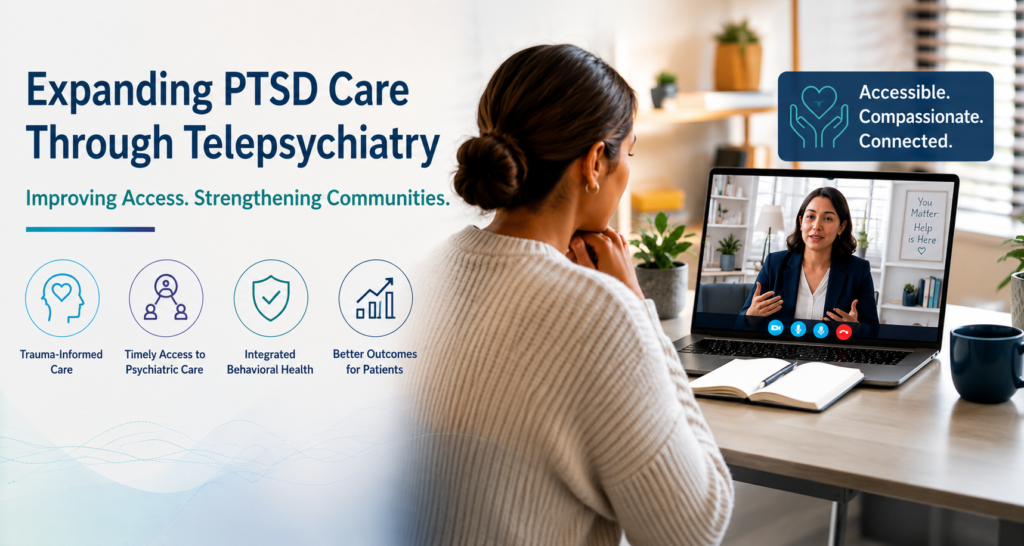
Federally Qualified Health Centers (FQHCs) and community health centers are experiencing increasing demand for behavioral health services nationwide. Among these services, PTSD (Post-Traumatic-Stress-Disorder) is one of the hardest conditions to manage. For healthcare leaders, expanding access to care is not simply a clinical challenge; it also involves having enough staff, organizing workflows, and making sure the system can keep working long-term.
Why PTSD Is Uniquely Difficult for Community Health Centers
PTSD rarely presents in isolation. Common comorbidities in patients experiencing trauma-related symptoms frequently include depression, anxiety, substance use disorders, chronic pain, and sleep disturbances. Coordinating care across primary care providers, behavioral health clinicians, psychiatrists, and community support services requires substantial infrastructure that many FQHCs are still building.
Without sufficient psychiatric resources, organizations struggle to provide timely, trauma-informed care, resulting in delayed diagnosis, treatment planning, and coordination with therapy services for the patients who need it most.
Common Challenges Facing FQHC Behavioral Health Programs
Most FQHC behavioral health programs operate under significant resource constraints while serving populations with complex behavioral health needs.
- Limited access to psychiatric specialists
- Rising behavioral health referral volumes
- Long wait times for psychiatric evaluation
- High rates of co-occurring conditions
- Workforce recruitment and retention difficulties
- Growing demand for integrated care
These challenges are a few common barriers among most rural and underserved populations, where access to specialty psychiatric care remains especially limited.
How Psychiatrist Shortages Affect FQHC Behavioral Health Programs
According to HRSA, more than 148 million people (approximately 43.3%) live in a Mental Health HPSA (Health Professional Shortage Area). The national psychiatrist shortage affects healthcare organizations across the country, with rural and underserved regions facing the steepest barriers. Many FQHCs report difficulty recruiting and retaining psychiatric providers due to:
- Geographic limitations and workforce competition
- Provider burnout and limited specialty coverage
- Increasing patient demand with limited budgets
For organizations that emphasize improving outcomes, addressing psychiatric workforce gaps has become a critical priority, as these gaps affect care coordination, patient retention, and long-term organizational growth.
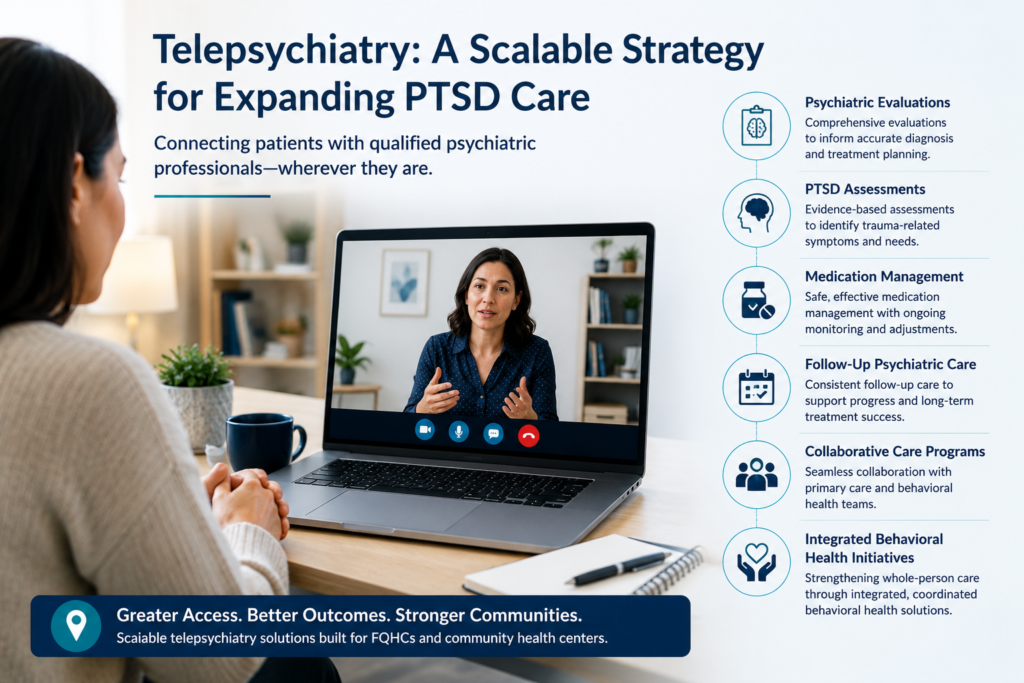
Telepsychiatry: A Scalable Strategy for Expanding PTSD Care
Unlike traditional staffing models that depend on local provider availability, telepsychiatry enables healthcare organizations to connect patients with qualified psychiatric professionals regardless of geographic location. For patients experiencing trauma-related symptoms, timely access to psychiatric evaluation can facilitate diagnosis, treatment planning, and coordination with therapy services.
Telepsychiatry services can support:
- Psychiatric evaluations
- PTSD assessments
- Medication management
- Follow-up psychiatric care
- Collaborative care programs
- Integrated behavioral health initiatives
A JAMA Network Open study of Medicaid patients treated at FQHCs found that higher telehealth availability was associated with increased mental health visit rates, including among patients with depression, anxiety, and stressor-related disorders.
Integrating Telepsychiatry Into Existing Behavioral Health Programs
Successful implementation of telepsychiatry into a program requires thoughtful planning across clinical and operational teams. Healthcare organizations should evaluate their needs based on:
- Referral and scheduling workflows
- Provider communication and care coordination protocols
- Documentation and quality reporting requirements
- Reimbursement and billing considerations
Organizations that align telepsychiatry with broader behavioral health initiatives are better equipped to improve access, strengthen care coordination, and meet long-term operational goals.
Building Sustainable Capacity Through Partnership
Expanding psychiatric services requires more than adding provider coverage. Sustainable behavioral health programs depend on effective care coordination, communication between clinical teams, and integration with existing workflows. Healthcare organizations increasingly seek telepsychiatry partners that collaborate across primary care, behavioral health, and administrative functions. Not just a partner that fills a scheduling gap.
Looking to Expand PTSD Care and Behavioral Health Services?
Learn how PMPI partners with FQHCs and community health centers to expand psychiatric capacity, reduce wait times, and strengthen integrated behavioral health programs through scalable telepsychiatry solutions.