
How behavioral health integration is helping healthcare organizations improve access, coordination, and continuity of care.

Primary care providers are often the first to recognize when a patient is struggling with depression, anxiety, substance use, or another behavioral health concern. The challenge isn’t identifying the need, it’s ensuring patients actually receive the support they need after that conversation takes place.
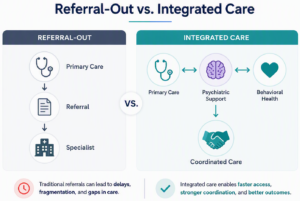
For years, the standard approach has been simple: make a referral and hope the patient follows through.
However, as healthcare organizations continue to face growing behavioral health needs, many are finding that referrals alone aren’t always enough.
Patients may encounter long wait times, transportation issues, insurance challenges, or stigma around seeking mental health care. Others simply get lost somewhere between the referral and the first appointment. When that happens, both patients and providers are left navigating gaps in care that can impact outcomes, engagement, and overall health.
That’s why more organizations are exploring behavioral health integration; specifically, how psychiatric support can become a more active part of the primary care experience.
Why Integration is Gaining So Much Attention
Behavioral health and physical health aren’t separate issues. They’re deeply connected.
A patient managing diabetes may also be struggling with depression. Someone experiencing chronic pain may be dealing with anxiety. When behavioral health needs go unaddressed, managing physical health conditions often becomes more difficult as well.
Integrated care models recognize this reality by bringing behavioral health expertise closer to where patients already receive care.
Instead of relying solely on external referrals, providers have access to collaborative resources that support earlier intervention, improved care coordination, and a more connected patient experience.
For healthcare organizations, that can mean:
- Better visibility into behavioral health needs across the patient population.
- Improved collaboration between care teams.
- Fewer patients falling through the cracks after a referral.
- More opportunities to address whole-person health within the primary care setting.
The Missing Piece: Access to Psychiatric Expertise
One of the biggest challenges facing primary care teams today is navigating psychiatric medication management without enough psychiatric resources available.
Demand for mental health services continues to increase, while access to psychiatrists remains limited in many communities. As a result, primary care providers often find themselves managing complex behavioral health needs with limited specialist support.
This is where integrated psychiatric support can make a meaningful difference.
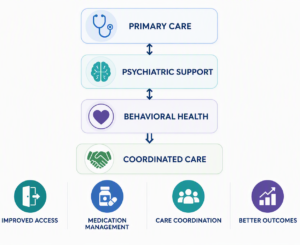
Rather than functioning as a separate service line, psychiatric consultants can work collaboratively with primary care teams to provide treatment recommendations, medication guidance, and support for patients whose needs extend beyond routine behavioral health management.
The result is a more connected care model, one that supports providers while helping patients access timely behavioral health treatment.
The Migration from Outbound Referrals to Collaborative Care
Many organizations are beginning to ask an important question:
What if behavioral health support didn’t begin after the referral? What if it was already part of the care team?
That’s the idea behind integrated care models such as the Collaborative Care Model (CoCM), which has one of the strongest evidence bases among behavioral health integration approaches. These models bring together primary care providers, behavioral health professionals, and psychiatric consultants to support patients through a coordinated care approach.
How PMPI Can Help
For organizations considering behavioral health integration, access to psychiatric medication management support is often a critical piece of the conversation.
PMPI works with healthcare organizations to provide psychiatric medication management services that can support broader behavioral health integration efforts. Whether you’re evaluating ways to strengthen care coordination, expand access to psychiatric expertise, or reduce reliance on traditional referral pathways, our team can help identify solutions that fit your clinical and operational goals.
Because at the end of the day, behavioral health integration isn’t simply about adding another service. It’s about helping patients receive the right support at the right time, while giving providers the resources they need to deliver truly connected care.
Ready to Explore Psychiatric Medication Management Integration?
Let’s talk about how psychiatric support can complement your behavioral health strategy.
Connect with PMPI to discuss psychiatric medication management solutions that support integrated behavioral healthcare.
Explore PMPI’s Telepsychiatry Solutions →
References
Agency for Healthcare Research and Quality. (n.d.). Integrated behavioral health & primary care: An overview. U.S. Department of Health and Human Services. https://integrationacademy.ahrq.gov
Agency for Healthcare Research and Quality. (n.d.). Integrating behavioral health and primary care playbook. U.S. Department of Health and Human Services. https://integrationacademy.ahrq.gov/products/playbooks/behavioral-health-and-primary-care
American Medical Association. (n.d.). Psychopharmacology how-to guide. https://www.ama-assn.org/system/files/bhi-psychopharmacology-how-to-guide.pdf
American Psychiatric Association. (n.d.). Behavioral health integration fact sheet. https://www.apa.org/health/behavioral-integration-fact-sheet
American Psychiatric Association. (n.d.). Integrated care. https://www.psychiatry.org/psychiatrists/practice/professional-interests/integrated-care
American Psychological Association. (n.d.). Behavioral health services in primary care: An essential component of integrated care. https://www.apa.org/health/behavioral-health-services-primary-care.pdf
Meadows Mental Health Policy Institute. (n.d.). Collaborative Care Model (CoCM) technical assistance tools. https://mmhpi.org/cocm/
Meadows Mental Health Policy Institute. (2026). Collaborative care (CoCM) key reference list. https://mmhpi.org/wp-content/uploads/2026/02/Internal_CoCM_Key_References.pdf