


Most healthcare organizations expect some delay between a referral being submitted and a patient being seen.
What many don’t realize is how quickly those delays can turn into lost opportunities for care.
A patient is referred for psychiatric services. A few days pass before outreach begins. The patient misses a call. Scheduling gets pushed out several weeks. Communication slows down. Before long, the patient is no longer engaged, has sought care elsewhere, or has simply given up on getting the support they need.
By the time anyone notices, the referral is cold.
This is a challenge we’re seeing across healthcare organizations nationwide. CMS reports that many referrals never reach completion, often because organizations lack consistent processes to track patients from referral through appointment scheduling and follow-up.
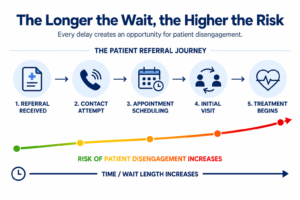
Waitlists are often viewed as an access issue.
In reality, they’re also a retention issue.
When patients encounter long delays, multiple handoffs, or limited communication, every additional step creates an opportunity for disengagement. Even highly motivated patients can lose momentum when the path to care becomes difficult to navigate.
For referring providers, that can create uncertainty about whether patients ever received the services they were referred for. For healthcare organizations, it can mean missed opportunities to keep patients connected to care within their network.
That’s why keeping patients engaged throughout the referral process isn’t just about filling appointment slots. It’s about helping ensure patients successfully move from referral to treatment.
Strong Referral Partnerships Depend on Visibility
Referrals are built on trust.
When a provider refers a patient for psychiatric services, they’re trusting that the patient will be contacted promptly, scheduled efficiently, and supported throughout the process.
The American Medical Association identifies timely communication and referral management as key components of successful referral relationships. Referring providers want confidence that patients are being seen and that the referral process is moving forward.
The organizations that tend to perform best are not necessarily the ones receiving the highest referral volume.
They’re the ones that have visibility into their referral pipeline.
They know:
- How quickly referrals are contacted
- How many referrals convert to appointments
- Where patients are dropping off
- Which bottlenecks are creating delays
- When outreach or intervention is needed
Those insights make it much easier to address small workflow issues before they become larger access challenges.
A Good Time to Review the Process
Many organizations are focused on expanding access to behavioral health services, which is important.
However, when psychiatry waitlists continue to grow, it may be worth evaluating whether referring patients elsewhere is the most effective long-term solution.
Every time a patient is referred outside the organization for psychiatric care, there is potential for delays,  insurance complications, communication gaps, and patient drop-off. Even when referrals are completed successfully, the process can create additional challenges for both patients and care teams.
At PMPI, we partner with healthcare organizations to bring psychiatric medication management services directly into clinic settings. By integrating psychiatric providers into existing care teams, organizations can reduce the need for external referrals and help patients access psychiatric care within the same setting where they already receive services.
When patients can receive psychiatric services within the same clinic where they already receive care, organizations can often improve access, strengthen care coordination, and create a more seamless patient experience.
Looking for a Better Way to Meet Psychiatric Care Needs?
Long waitlists and referral delays don’t just affect patient access. They can also create challenges for providers, care teams, and organizations working to keep patients engaged in treatment.

PMPI helps healthcare organizations expand access to psychiatric medication management services by embedding experienced psychiatric providers within clinic settings. The result is a more connected care experience for patients and fewer barriers between identifying a need and receiving treatment.
Let’s talk about how psychiatric support can complement your behavioral health strategy.
Connect with PMPI to discuss psychiatric medication management solutions that support integrated behavioral healthcare.
Explore PMPI’s Telepsychiatry Solutions →