

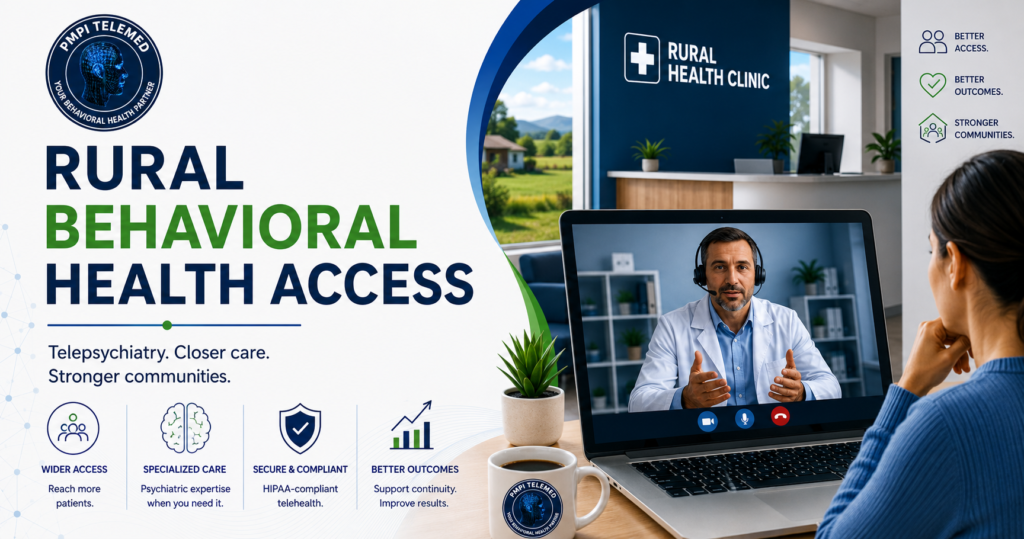
Rural behavioral health access remains constrained by distance, even when demand is visible to local care teams. A 2025 University of South Carolina Rural Health Research Center brief found that 40.76% of small or isolated rural ZIP Code Tabulation Areas were more than 30 minutes from any mental health facility, compared with 9.4% of urban areas.
Medicare telehealth policy now gives rural healthcare leaders a more stable platform for addressing that gap. The opportunity is to translate federal flexibility into reliable psychiatric capacity, coordinated workflows, and continuity of care.
Why Rural Behavioral Health Access Matters
Rural Health Clinics and rural hospitals often coordinate care across long distances, limited specialty networks, and small teams carrying multiple responsibilities. When psychiatric expertise is not consistently available, referrals may become harder to complete, and primary care teams may have fewer options for consultation and follow-up.
Federal policy creates room to strengthen rural behavioral health delivery. However, policy permission alone does not establish clinical coverage, scheduling capacity, documentation standards, or communication between remote clinicians and local teams. Those operating decisions determine whether access becomes dependable rather than episodic.
Core Access and Workforce Barriers
Many rural organizations already use virtual care, external referrals, or periodic specialty coverage. The remaining challenge is turning separate efforts into a consistent care pathway.
- Limited local psychiatric recruitment
- Long travel distances for patients
- Inconsistent broadband or video access
- Fragmented referral and follow-up processes
- Competing demands on primary care staff
These barriers can delay evaluation, complicate medication follow-up, and increase coordination work. They can also lead patients to disengage before specialty care begins. A sustainable response must protect continuity and quality while fitting the organization’s actual staffing, technology, and financial capacity.
Telepsychiatry and Integrated Behavioral Health
Rural telepsychiatry is more than placing a remote clinician on a screen. Unlike local recruitment alone or short-term coverage, it can connect ongoing specialty capacity with the care settings patients already use. Depending on organizational needs, a coordinated model may support:
- Psychiatric evaluations
- Medication management and follow-up
- Consultation with local care teams
- Specialty input for complex referrals
- Care coordination across service settings
This structure allows scarce psychiatric expertise to support multiple communities without assuming every encounter belongs in virtual care.
PMPI TeleMed supports rural healthcare organizations by helping connect psychiatric access, behavioral health integration, and operational planning. For leaders facing limited local specialty capacity, telepsychiatry can be part of a broader strategy to extend care while reinforcing—not replacing—the relationships and clinical judgment of local teams.
Implementation and Sustainability
Implementation should begin with the care pathway, not the technology. Rural leaders should define:
- Which patients and services enter the virtual pathway
- How referrals, scheduling, consent, and escalation are handled
- Where documentation and medication-management responsibilities reside
- How remote clinicians communicate with primary care and community partners
- Which access, continuity, utilization, and financial measures will be reviewed
Technology readiness also requires alternatives for patients who cannot reliably use video. Medicare permanently permits audio-only behavioral and mental telehealth, while privacy, clinical appropriateness, and documentation still require disciplined processes.
Reimbursement and coding should be validated for the organization’s setting and payer mix. Clear ownership turns policy flexibility into durable access rather than an isolated virtual service.
Future Outlook
The federal outlook gives rural organizations both stability and a planning deadline. Rural Health Clinics can permanently serve as Medicare distant-site providers for behavioral and mental telehealth, while the related in-person visit requirement remains waived through December 31, 2027. Leaders can use this period to strengthen workflows, measure performance, and prepare for later policy changes without postponing today’s access work.
Looking to Expand Rural Behavioral Health Services?
Learn how PMPI partners with rural healthcare organizations to expand psychiatric capacity, reduce wait times, and strengthen integrated behavioral health programs through scalable telepsychiatry solutions.
Frequently Asked Questions
Which rural behavioral-health telehealth provisions are permanent?
Rural Health Clinics can permanently act as Medicare distant-site providers for behavioral and mental-health telehealth. Medicare also permanently permits home-based care without geographic restrictions and allows audio-only delivery.
Does the 2027 extension guarantee reimbursement?
No. Coverage authority does not replace payer-specific coding, documentation, eligibility, and billing requirements. Organizations should validate their workflows against current Medicare guidance and other payer rules.
Where should rural leaders begin?
Start with the patient pathway. Define referral criteria, clinical responsibilities, scheduling, documentation, escalation, follow-up, technology alternatives, and performance measures before expanding capacity.